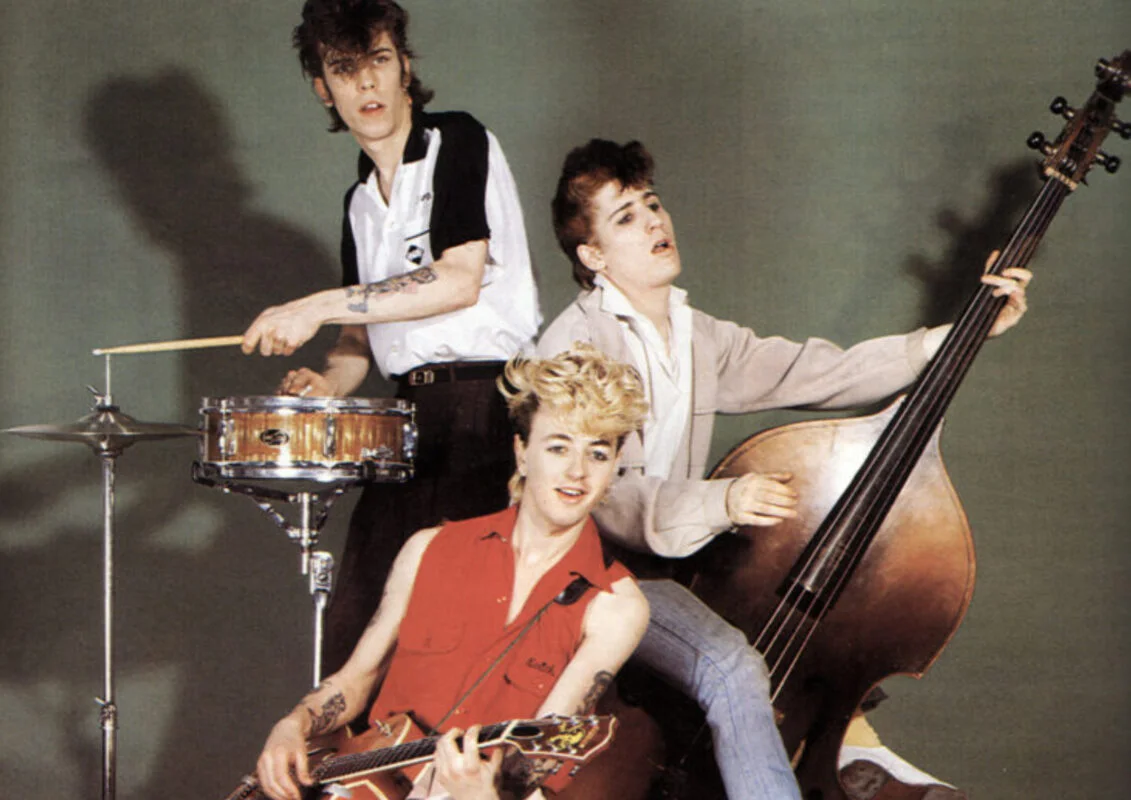
Let’s continue raving about Eddie Cochran—see this previous post—via his true disciple: Brian Setzer.
Setzer sees Cochran as a truer “punk” than the Sex Pistols due to his combative attitude in a repressive era. While 1970s punk was a collective movement, Cochran stood alone in the 1950s as an independent artist who wrote his own songs and played aggressive lead guitar. Setzer argues that Cochran’s “don’t mess with me” persona was a genuine rebellion, predating the manufactured anger of later decades.
The visual link between the two is the Gretsch 6120 guitar. As a teenager, Setzer specifically hunted for the orange hollow-body model made famous by Cochran. The decision became the Stray Cats’ identity. By using the same instrument as his hero, Setzer bridged the gap between vintage rock and roll and the high-volume needs of the modern stage.
Setzer’s technique adopted Cochran’s aggressive power chords and driving rhythm, which he further intensified. He turned the polite “twang” of early rock into a saturated “growl” by using Fender Bassman amps and Roland Space Echo units. This allowed him to keep the technicality of rockabilly while matching the sonic weight of contemporary rock.


In the late 1970s, Setzer placed the Stray Cats within the punk scenes of New York & London. Instead of treating rockabilly as a museum piece, he used it as a weapon against disco. The band’s DIY ethos & high-speed performances resonated with punk audiences who saw the shared DNA of street-level defiance. This led to a global “neo-rockabilly” movement.
In the 1990s, Setzer formed the Brian Setzer Orchestra, moving from a trio to a 17-piece big band. He refused to soften his sound, instead treating the brass sections as a “wall of sound.” He utilized horn arrangements to provide the same rhythmic punch as a distorted guitar, blending “jump blues” with rockabilly energy.
The success of this orchestra sparked a worldwide swing revival. Setzer proved that the music of Cochran was harmonically sophisticated enough for large-scale arrangements. His career remains a tribute to the 1950s rebel spirit, reimagined through modern innovation and guitar virtuosity.
💧 You might also like THE HYDRANT: HEPCAT, GREASER, ATAU ROCKABALI?
⎯⎯⎯⎯⎯
Featured image via Spiegel.